

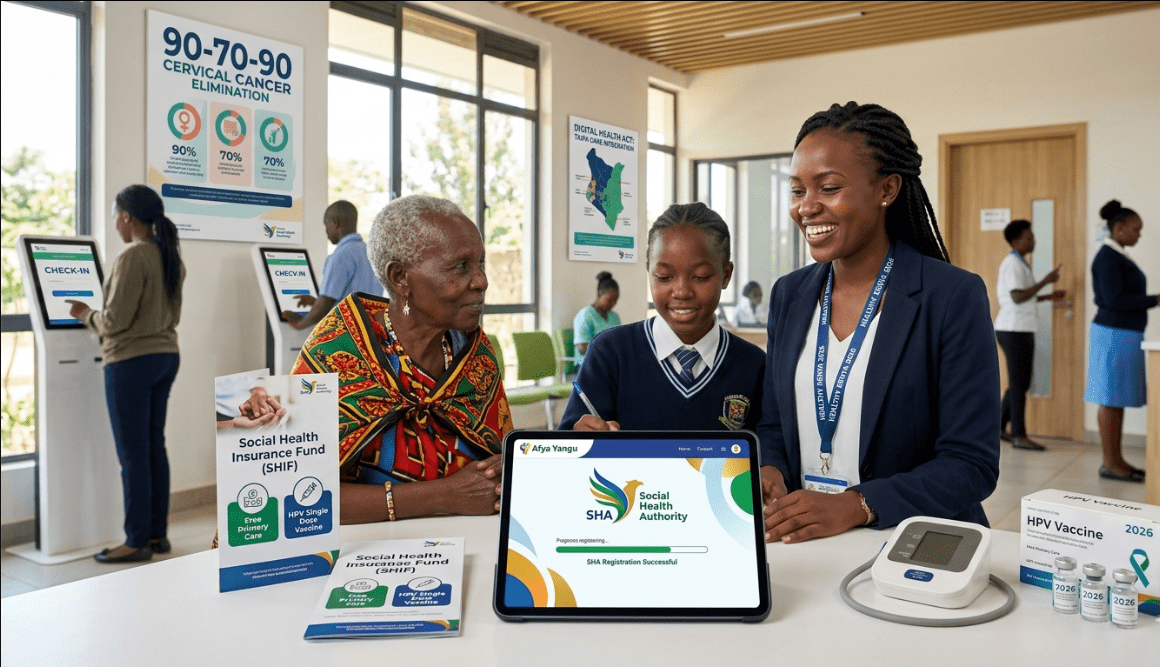
 As of May 2026, the landscape of public health in Kenya is undergoing its most significant transformation in decades. The full transition from the legacy NHIF to the Social Health Authority (SHA), the implementation of the Digital Health Act, and the launch of the National Cervical Cancer Elimination Action Plan (2026-2030) have fundamentally changed how Kenyans access care. In this new era, public health advocacy is the bridge between these ambitious policies and the actual health and well-being of every citizen.
1. The New Era of Universal Health Coverage: SHA & SHIF
The most critical shift in 2026 is the legal and operational anchoring of the Social Health Insurance Fund (SHIF). Following recent High Court rulings affirming its constitutionality, registration is now a mandatory requirement for all residents.
Public health advocacy today focuses on navigating the “Means Testing” system-an AI-driven economic assessment that determines premiums for informal sector workers. Advocates are working to ensure that the minimum contribution of KSh 300 remains fair and that no Kenyan is denied emergency care, as mandated by the recent judicial supervision of the SHA.
The Primary Healthcare Fund: This is a major advocacy win. It provides free access to Level 2 (Dispensaries) and Level 3 (Health Centers) for all registered Kenyans, regardless of their payment status.
SHIF (2.75%): Salaried and non-salaried contributors fund access to specialized Level 4-6 referral hospitals.
2. Combating the Rising NCD Crisis
Non-communicable diseases (NCDs) now account for nearly 39% of deaths in Kenya. In response, the Ministry of Health’s Local Manufacturing Strategy 2025-2030 aims to produce 50% of essential medicines locally to reduce the cost of treating chronic conditions like hypertension and diabetes.
Advocacy in 2026 has moved to the household level through Community Health Promoters (CHPs). Armed with digital kits, these 100,000+ workers are the frontline of defense, conducting door-to-door screenings and ensuring patients are linked to the newly subsidized NCD management programs under the SHA.
3. Cervical Cancer: The Road to Elimination
Kenya has taken a bold step forward with the National Cervical Cancer Elimination Action Plan 2026-2030. The goal is the global 90-70-90 target:
90% of girls vaccinated with the HPV vaccine by age 15.
70% of women screened using high-performance HPV DNA tests by ages 35 and 45.
90% of women with cervical disease receiving treatment.
A key 2026 milestone is the widespread adoption of the single-dose HPV vaccine schedule, which has simplified logistics and drastically increased coverage in schools. Advocacy now centers on promoting self-sampling kits, allowing women to screen for HPV in the privacy of their homes.
4. Digital Health and Health Security
The Digital Health Act has birthed the TaifaCare platform, integrated with the eCitizen Digital ID. For the first time, Kenyans have a portable digital health record. However, this has opened a new frontier for advocacy: Data Privacy and Equity. Advocates are working to ensure that those without smartphones are not left behind and that biometric data is used ethically.
Furthermore, Kenya is currently a lead voice in the global Pathogen Access and Benefit-Sharing (PABS) talks. Having learned the lessons of the COVID-19 pandemic, Kenyan advocacy groups are demanding that virus-sharing be tied to guaranteed local access to vaccines and treatments to prevent “vaccine apartheid” in future outbreaks.
Call to Action: Your Role in 2026
Building a “Healthy Kenya” is no longer a top-down government mandate; it is a community-driven movement. You can take action today by:
Registering for SHA: Dial *147# or visit the Afya Yangu portal to ensure your family is covered.
Utilizing Primary Care: Visit your local Level 2 or 3 facility for routine screenings-these are your right under the Primary Healthcare Fund.
Advocating for Access: Use the mandatory Service Charters posted at hospitals to hold providers accountable for the services and fees they display.
In conclusion, while the challenges of NCDs and infectious diseases remain, the tools available in 2026-from digital records to unified insurance-provide a stronger foundation than ever before. Through active advocacy and community participation, we can turn these policies into a lived reality for every Kenyan.